There is a side of Bangladesh that many international travelers never get to see.
Beyond Dhaka’s traffic, busy streets, markets, and rapidly changing skyline are communities where traditional skills are still part of everyday life.
In these places, work begins with simple materials.
Clay.
Water.
Hands.
A spinning wheel.
And knowledge passed from one generation to another.
A pottery village tour in Bangladesh offers the opportunity to step inside this world and meet the people who continue to keep one of the country’s oldest craft traditions alive.
Instead of simply visiting a museum or looking at finished souvenirs, you can watch the creative process unfold in front of you.
You may see clay being prepared.
You may watch a potter shape a vessel with practiced movements.
You may see rows of newly formed pots drying in the open air.
Depending on the experience, you may even have the opportunity to sit at a pottery wheel and try creating something yourself.
For travelers who want to experience Bangladesh beyond its famous landmarks, this is one of the most personal and memorable cultural activities near Dhaka.
A pottery village tour Bangladesh experience is not about checking another attraction off your list.
It is about slowing down.
Meeting local artisans.
Understanding traditional craftsmanship.
And seeing how culture survives through the skills of ordinary people.
Why Visit a Pottery Village in Bangladesh?
Modern travel often focuses on famous landmarks.
You visit a fort.
You photograph a monument.
You walk through a historic district.
Then you move to the next destination.
A pottery village offers something different.
The experience is centered around people.
You are not only looking at something created in the past.
You are watching a living tradition.
That difference matters.
Traditional pottery connects visitors with several aspects of Bangladesh at the same time:
- Local craftsmanship
- Rural life
- Family traditions
- Handmade production
- Cultural heritage
- Everyday creativity
- Traditional materials
- Generational knowledge
For travelers from the USA and other international destinations, this can be a particularly meaningful experience.
In many parts of the world, handmade production has become increasingly separated from daily life.
People buy finished products without seeing where they came from or who made them.
A pottery village creates the opposite experience.
You can see the process.
You can meet the makers.
You can understand how much skill exists behind an object that might otherwise seem simple.
A clay pot may begin as soil.
But through the hands of a skilled artisan, it becomes something useful, beautiful, and connected to generations of cultural knowledge.
Meet the Local Artisans Behind Bangladesh’s Traditional Pottery
The most memorable part of a pottery village tour is often not the pottery itself.
It is the people.
When you visit an artisan community, you have the opportunity to observe craftspeople in their working environment.
Their homes, workshops, courtyards, tools, and daily routines may all become part of the experience.
For generations, pottery has often been a family-based craft.
Skills are learned through observation and practice.
Children grow up watching older family members work.
Over time, they learn how to prepare clay, control the wheel, shape different forms, and understand the firing process.
This kind of knowledge cannot always be explained through a textbook.
It is learned through repetition.
A skilled potter understands the material through touch.
They know when the clay has the right consistency.
They know how much pressure to apply.
They know how quickly the wheel should move.
They know when a piece is ready for the next stage.
Watching this process helps visitors understand why handmade craftsmanship is so valuable.
The final product may look simple.
The skill behind it is not.
From Clay to Pot: What You Can Experience
One of the best reasons to take a pottery village tour in Bangladesh is the opportunity to see the complete journey behind a handmade object.
While every artisan and village may follow slightly different methods, the experience can introduce visitors to several stages of traditional pottery-making.
Preparing the Clay
Everything begins with clay.
Before a pot can take shape, the material must be prepared properly.
The clay needs the right texture and consistency before it can be used on a wheel or shaped by hand.
This early stage may not look as dramatic as the spinning pottery wheel, but it is essential.
Without properly prepared clay, the final product may not hold its shape.
For travelers, this is an important reminder that traditional crafts involve much more than the moment you see on social media.
The finished pot represents a complete process.
Shaping the Pottery
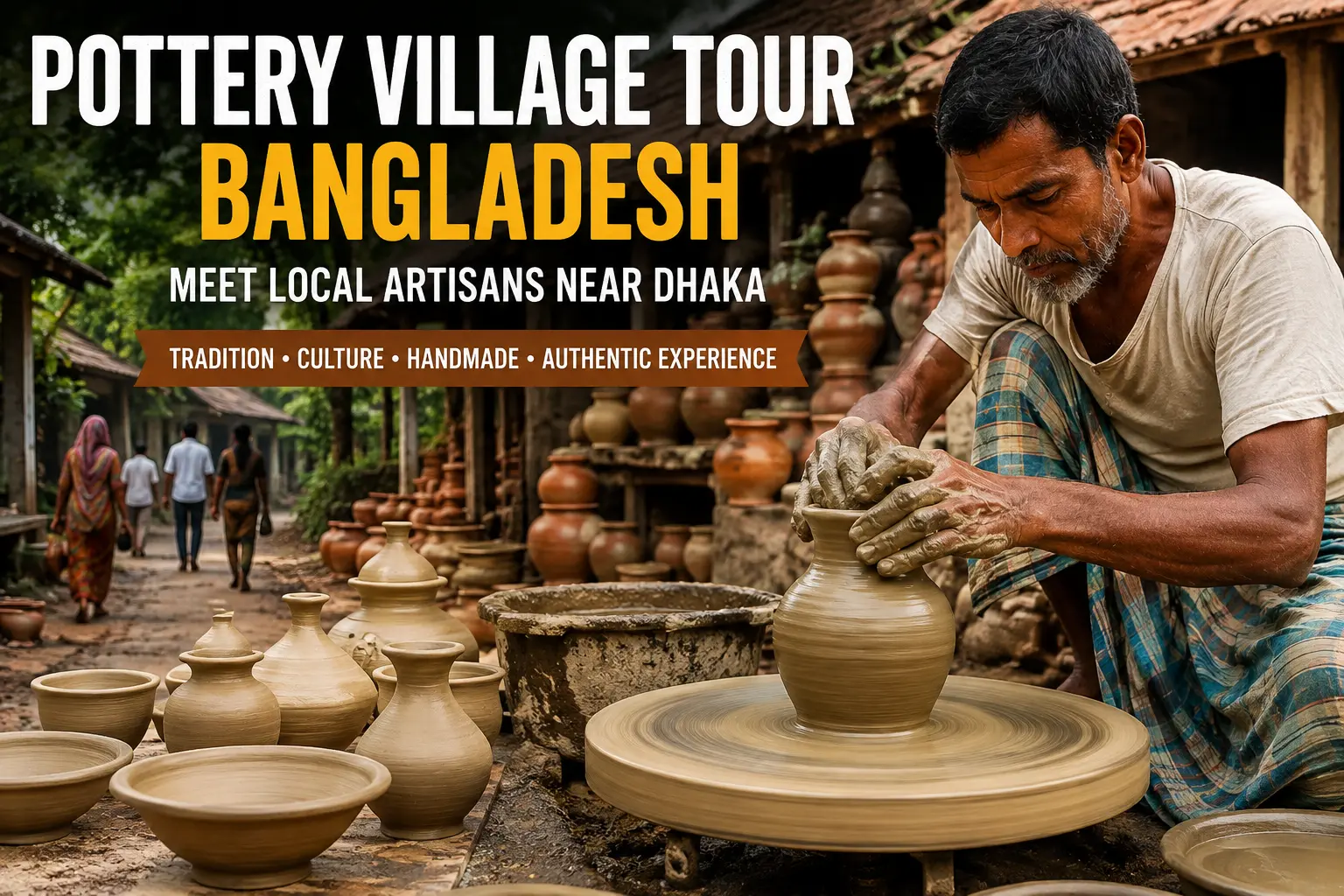
Watching a skilled potter work is one of the highlights of visiting a traditional pottery village. The process often begins with what appears to be nothing more than a small lump of clay placed at the center of the wheel. As it starts to spin, the potter uses years of experience to guide the clay with subtle movements of the hands, gradually giving it form.
Within a few minutes, the shapeless clay may begin to resemble a bowl, a cooking pot, a water vessel, or another familiar household object. What makes the process fascinating is how naturally an experienced artisan works. There is no unnecessary movement or dramatic performance; the skill comes from knowing exactly how much pressure the clay can take and how to adjust its shape as the wheel turns.
For visitors, it is a simple but revealing experience. Seeing a finished clay pot in a market is one thing, but watching it take shape in the hands of the person who made it gives the object an entirely different meaning.
Try Pottery Yourself
Watching a skilled artisan work is impressive.
Trying it yourself is humbling.
A hands-on pottery experience gives visitors the opportunity to understand the craft from another perspective.
The clay may not cooperate.
The wheel may move faster than expected.
Your first attempt may collapse before becoming anything recognizable.
And that is part of the experience.
Trying pottery can help you appreciate how much skill is involved in creating objects that experienced artisans make appear effortless.
You do not need to become a potter.
The goal is simply to experience the process.
Feel the clay.
Try to control the shape.
Understand the relationship between your hands and the spinning wheel.
For families, couples, photographers, and cultural travelers, this interactive experience can become one of the most memorable moments of the day.
Experience Rural Bangladesh Beyond Dhaka
A pottery village tour Bangladesh experience is also about seeing another side of the country.
Dhaka is energetic, crowded, fast-moving, and constantly changing.
Rural artisan communities offer a different rhythm.
The journey itself can become part of the experience.
As you move away from central Dhaka, the urban environment gradually changes.
Large buildings become less dominant.
Open spaces increase.
Local markets, agricultural landscapes, waterways, and village roads begin to shape the journey.
By the time you arrive at an artisan community, you are experiencing a very different environment from the capital.
This contrast is one of the reasons cultural day trips can add so much value to a Bangladesh itinerary.
You begin to understand that Bangladesh cannot be represented by one city alone.
The country has many different rhythms.
A pottery village allows you to experience one of them.
Why Traditional Pottery Matters to Bangladesh’s Cultural Heritage
Traditional crafts are more than souvenirs.
They are forms of cultural memory.
A handmade object can preserve knowledge about:
- Local materials
- Traditional techniques
- Community identity
- Household life
- Religious practices
- Ceremonies
- Regional artistic styles
When a traditional craft disappears, something more than a business can be lost.
A connection between generations can disappear as well.
That is why visiting local artisans can be more meaningful than simply shopping for handmade products.
Your visit recognizes the value of the craft.
When travelers show interest in traditional skills, ask questions, and purchase directly from artisans where appropriate, cultural tourism can help create greater appreciation for living traditions.
This is one reason a pottery experience works so well as A Cultural Tour.
You are not simply traveling through a destination.
You are engaging with the people and traditions that give the destination its identity.
What Makes a Pottery Village Tour Different From a Regular Sightseeing Tour?
A traditional sightseeing tour is often destination-focused.
You travel to a place.
You look around.
You take photographs.
Then you continue.
An artisan experience is more process-focused.
The activity itself becomes the attraction.
There is no need for a massive building or famous monument.
The value comes from observation and interaction.
During a pottery village visit, you can:
- Meet local craftspeople
- Watch pottery being made
- Learn about traditional techniques
- Explore village surroundings
- Try pottery yourself
- Take photographs
- Ask questions
- Purchase handmade items directly when available
This creates a more personal travel experience.
You are not only learning about history from the past.
You are seeing a tradition that continues in the present.
A Perfect Cultural Day Trip From Dhaka
For travelers staying in Dhaka, a pottery village visit can be part of a broader cultural day trip.
Depending on your interests and available time, the experience may be combined with other elements of Bangladesh’s cultural heritage.
A broader itinerary could include:
- A traditional pottery village
- Local artisan workshops
- A rural village experience
- A scenic journey through the countryside
- Traditional Bangladeshi food
- Historical or cultural landmarks
- Brass artisans and traditional metalwork
The ideal itinerary should not feel rushed.
The most important part of the experience is spending enough time with the artisans and understanding the process.
There is little value in arriving for ten minutes, taking photographs, and immediately leaving.
Slow travel works particularly well here.
Give yourself time to observe.
Watch how the artisans work.
Walk around the village.
Look at the pottery drying outside.
Notice the tools.
Ask about the different types of products being made.
The more curious you are, the more rewarding the experience can become.
Combine Pottery With Traditional Brass Artisans
Pottery and metalwork create an interesting cultural combination.
One begins with clay.
The other works with metal.
Both require patience, skill, experience, and generations of knowledge.
For travelers who want a broader artisan experience, combining pottery with traditional brass craftsmanship can provide a fuller understanding of Bangladesh’s handmade heritage.
You can see how different materials require completely different techniques.
Clay responds to pressure and moisture.
Metal requires a more complex process involving shaping, casting, heating, and finishing.
The contrast between these crafts makes a combined artisan journey particularly interesting.
However, pottery should not become a secondary attraction.
It deserves time and attention on its own.
That is why a dedicated pottery village tour Bangladesh guide can help travelers understand what makes this experience special before they choose a wider cultural itinerary.
Is a Pottery Village Tour Good for Photography?
Yes.
For photographers, artisan communities can offer some of the most authentic visual experiences near Dhaka.
The strongest photographs often come from real moments rather than staged scenes.
You may find opportunities to photograph:
- Potters working at the wheel
- Hands covered in clay
- Traditional tools
- Rows of drying pottery
- Kilns and workshops
- Rural homes
- Village life
- Textures and patterns
- Portraits, with permission
- The process of making handmade objects
The best approach is respectful photography.
Do not treat people as props.
Ask before taking close portraits.
Show interest in what they are doing.
Spend time understanding the environment before immediately raising your camera.
This usually leads to better photographs and a more meaningful interaction.
For travelers who enjoy documenting everyday life, a pottery village experience can complement a Street Photography Tour in Dhaka.
The two experiences show very different visual sides of Bangladesh.
One captures movement, density, and urban life.
The other focuses on craftsmanship, rural communities, and slower moments.
Is This Experience Suitable for Families?
Yes.
A pottery village visit can be especially enjoyable for families because it combines education with interaction.
Children can see how everyday objects are made.
They can learn about materials.
They may have the opportunity to try pottery themselves.
Adults can explore the cultural and historical significance of the craft.
The experience also gives families an opportunity to spend time outside the busy environment of Dhaka.
The exact itinerary should always be adjusted according to the ages and interests of the travelers.
Families with younger children may prefer a shorter and more interactive experience.
Older children and teenagers interested in art, history, photography, or culture may enjoy spending additional time with local artisans.
What Should You Bring on a Pottery Village Tour?
The best approach is to travel light and comfortably.
Consider bringing:
- Comfortable walking shoes
- Lightweight clothing
- Drinking water
- Sun protection
- A camera or smartphone
- A small amount of local currency for personal purchases
- Hand sanitizer or tissues
- A light rain layer during the rainy season
If you plan to try pottery, do not wear clothing that you would worry about getting dirty.
Clay is part of the experience.
The Best Time for a Pottery Village Tour in Bangladesh
A pottery village can be visited throughout much of the year, but weather can affect the overall comfort of the journey.
The cooler months are generally more comfortable for spending time outdoors and traveling between Dhaka and rural areas.
However, every season offers a different experience.
During the dry season, travel conditions may be easier for sightseeing.
During the rainy season, the countryside can become greener and waterways may become more visually dramatic.
The best choice depends on your travel schedule and interests.
If you are planning a specific artisan experience, it is always best to confirm the current itinerary and local conditions before traveling.
How to Respectfully Meet Local Artisans
Cultural tourism works best when it creates a positive experience for both visitors and local communities.
When visiting a pottery village, remember that you are entering a working environment.
The people you meet are not performing a show.
They are continuing their daily work.
A respectful visitor should:
- Ask before taking close photographs
- Avoid interrupting artisans while they work
- Show genuine interest in the process
- Ask questions respectfully
- Avoid touching unfinished work without permission
- Purchase directly from artisans when appropriate
- Respect local customs and personal space
Small interactions can make a major difference.
A simple conversation about how an object is made can often become more memorable than another photograph.
Why Buy Handmade Pottery Directly From Artisans?
A handmade object can become a meaningful souvenir because you understand where it came from.
Instead of buying a generic item from a tourist shop, you may be able to purchase something connected directly to the person or community that created it.
Every handmade item may contain small differences.
That is part of its value.
Handmade pottery does not need to be perfectly identical.
Its individuality reflects the human process behind it.
If you choose to purchase directly from an artisan, you also create a stronger connection between your travel experience and the community you visited.
Years later, a small clay object can remind you of:
- The village
- The people
- The sound of the pottery wheel
- The smell of clay
- The conversation you had
- The process you watched
That is what makes cultural souvenirs different.
They carry a story.
How a Pottery Village Fits Into Your Bangladesh Itinerary
A pottery village experience can be an excellent addition to a first trip to Bangladesh.
If you are beginning your journey in Dhaka, you may first want to Discover Dhaka City and experience the energy of the capital.
Afterward, an artisan village offers a completely different perspective.
Travelers interested in historic neighborhoods can also experience an Old Dhaka Tour, where narrow streets, markets, food, and historic landmarks reveal another side of the country’s cultural identity.
For a broader journey through Bangladesh, you can continue beyond Dhaka to destinations that offer completely different landscapes and experiences.
A Sreemangal and Sylhet Tour introduces travelers to tea gardens, forests, hills, and northeastern culture.
A Sundarbans and Bagerhat Tour offers wildlife, waterways, and important historical architecture.
Together, these experiences show why Bangladesh is much more diverse than many first-time visitors expect.
Why Choose a Guided Pottery Village Experience?
It is possible to explore independently, but a guided cultural experience can make the journey easier and more meaningful.
A guide can help with:
- Transportation planning
- Communication with local artisans
- Cultural interpretation
- Itinerary management
- Finding the right workshops
- Understanding local traditions
- Creating a comfortable travel experience
For international visitors, this can remove much of the uncertainty involved in arranging a visit to a rural artisan community.
The most important advantage is context.
A good guide should not simply point at something and tell you its name.
They should help you understand why it matters.
When choosing the Best Tour Agency in Bangladesh, look for an experience that prioritizes local knowledge and respectful cultural interaction rather than simply moving visitors from one attraction to another.
Is a Pottery Village Tour in Bangladesh Worth It?
Yes, especially if you want to experience something more personal than traditional sightseeing.
The experience may not have the scale of a famous monument.
It does not need to.
Its value comes from authenticity.
You can meet the people behind the craft.
You can watch a skill that takes years to develop.
You can understand how ordinary materials become handmade objects.
You can spend time in a rural environment outside Dhaka.
And you can experience a part of Bangladesh that many travelers never see.
For culture-focused travelers, this can become one of the most memorable days of the entire trip.
Plan Your Pottery Village Experience Near Dhaka
A pottery village tour Bangladesh experience gives you the opportunity to see the country through the hands of its artisans.
You begin with clay.
Then you watch the wheel turn.
Slowly, a shape appears.
What began as a simple material becomes something useful and beautiful.
But the real story is not the pot.
It is the person making it.
The knowledge behind their movements.
The family tradition.
The community.
The connection between craft and culture.
For travelers who want to move beyond the standard tourist experience, meeting local artisans can offer a deeper understanding of Bangladesh.
It is slower.
More personal.
And far more memorable than simply looking at another landmark from a distance.
FAQ
What is a pottery village tour in Bangladesh?
A pottery village tour is a cultural travel experience where visitors explore traditional artisan communities, watch local potters work with clay, learn about pottery-making techniques, and sometimes try creating pottery themselves.
Where can I visit a pottery village near Dhaka?
Traditional artisan communities can be visited on cultural day trips from Dhaka. The exact route and village experience depend on the tour itinerary and local arrangements.
Can tourists meet local potters in Bangladesh?
Yes. A guided pottery village experience can allow travelers to visit artisan communities, observe potters at work, learn about traditional techniques, and interact respectfully with local craftspeople.
Can I try making pottery during the tour?
Depending on the itinerary and local arrangements, visitors may have the opportunity to try traditional pottery-making under the guidance of local artisans.
How long does a pottery village tour take?
The duration depends on whether the experience focuses only on pottery or combines pottery with other cultural activities. A dedicated visit may take several hours, while a broader artisan and cultural experience can become a full-day trip.
Is a pottery village tour suitable for international travelers?
Yes. It is particularly suitable for international travelers interested in local culture, handmade crafts, photography, rural life, and authentic experiences beyond major tourist attractions.
Is a pottery village tour good for photographers?
Yes. Pottery-making offers opportunities to photograph artisans at work, traditional tools, handmade objects, rural environments, textures, and the process of transforming clay into finished pottery.
What should I wear for a pottery village visit?
Wear comfortable clothing and walking shoes suitable for a rural cultural experience. If you plan to try pottery yourself, choose clothing that you do not mind getting slightly dirty.
Can I buy pottery directly from local artisans?
Depending on the village and workshop, visitors may have opportunities to purchase handmade pottery directly from local artisans.
Is a pottery village tour suitable for families?
Yes. Families can enjoy the combination of culture, education, interaction, and hands-on creativity. The itinerary can be adapted according to the ages and interests of the travelers.
What is the best time to visit a pottery village in Bangladesh?
The cooler months are generally more comfortable for cultural day trips and outdoor exploration, although pottery village experiences may be available at different times of the year depending on local conditions.
Can I combine a pottery village with other cultural experiences?
Yes. A pottery village can be combined with traditional artisan workshops, rural experiences, historic landmarks, and other cultural attractions as part of a longer day trip from Dhaka.